
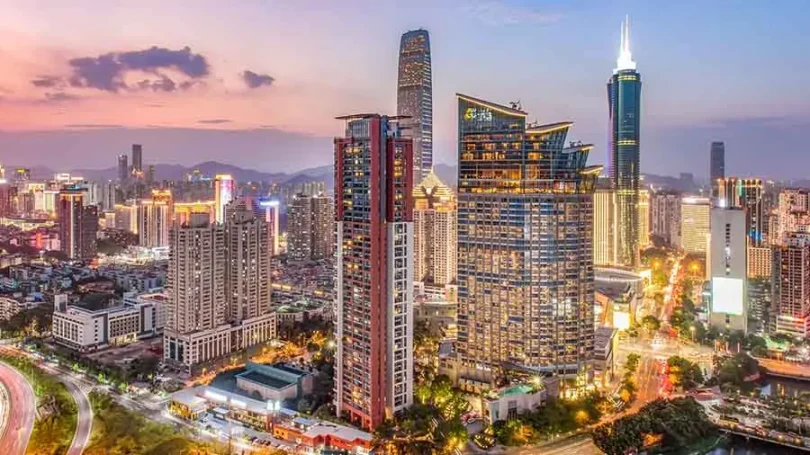

When Chinese leader Deng Xiaoping designated Shenzhen as a Special Economic Zone in 1980, only a few could have predicted that the quiet fishing town with a population of roughly 30,000 people, beside bustling Hong Kong, would evolve into one of the world’s biggest manufacturing and technology powerhouses in today’s world. The differences between both periods paint a vivid picture of how rapidly the economic landscape shifts when policies are properly thought through and put into effect, even when it takes decades to achieve the desired results.
Unlike major Chinese cities such as Beijing or Shanghai, Shenzhen earlier had little industrial significance and almost no global economic influence. However, its strategic location beside Hong Kong, then one of Asia’s busiest commercial and export centres, made it an ideal testing ground for China’s economic reforms. Chinese leaders believed the city could serve as a controlled gateway for foreign investment, export manufacturing and international trade, without exposing the entire country to the risks of rapid economic liberalisation.
At the time, China was still emerging from decades of economic isolation, with weak industrial capacity and limited foreign investment. Over four decades later, Shenzhen has evolved into a global economic powerhouse with 17 million inhabitants, housing some of China’s largest technology companies, totalling 2.23 million commercial entities and 424 listed companies as of 2023, and one of the busiest ports in the world. Its Gross Domestic Product contribution of $550 billion in 2025 now rivals that of several countries, while its factories and technology parks have become symbols of China’s rise as the “factory of the world”, to the envy of nations.
But the most important lesson from Shenzhen is often misunderstood. This transformation was not built primarily on tax waivers or generous incentives. It was built on infrastructure.
Thirdly, infrastructure strengthens regional trade integration and unlocks the real promise of AfCFTA. The trade agreement aims to create a single African market of more than 1.4 billion people, but trade liberalisation on paper alone will not automatically create industrial growth. Regional commerce depends on roads, rail corridors, ports, customs systems and digital trade infrastructure capable of moving goods across borders efficiently. Without those systems, African manufacturers will struggle to compete, even within the continent. Shenzhen succeeded because it connected production directly to export logistics. African economies must now replicate that model by linking industrial zones to transport corridors and maritime infrastructure. If properly integrated, emerging hubs such as Lekki could evolve into regional export centres serving West Africa and beyond. But without infrastructure, AfCFTA risks becoming merely a framework for importing foreign goods, rather than a catalyst for African industrialisation.
More important is policy coordination and institutional consistency. China combined infrastructure investment with streamlined regulations, simplified customs systems and long-term planning that gave investors confidence in the stability of the business environment. In many African economies, however, policy reversals, multiple taxation and bureaucratic bottlenecks continue to discourage manufacturers. Infrastructure alone cannot drive industrialisation if regulatory systems remain unpredictable. Governments must therefore treat infrastructure development and policy stability as complementary pillars of economic transformation.
The Shenzhen experience ultimately demonstrates that industrial transformation is not accidental. It requires deliberate planning, sustained infrastructure investment and a long-term economic vision. Africa today stands at a similar crossroads. The continent possesses abundant natural resources, a rapidly growing population and one of the world’s largest emerging consumer markets. But without functioning infrastructure, industrial ambitions under AfCFTA may remain unrealised.
Damilola Aina is a 2026 Free Trade Fellow at the Ominira Initiative. He can be reached via X: @AinaDhamires.

Leave a Comment