

Africa has never been more strategically important, and yet strategic importance does not automatically produce economic power. Many significant aspects of the global economic order are shifting. Unlike the past, Africa is no longer a mere object of global economic policies, as seen from the competition between the United States and China, growing European strategic interest and presence in Africa, and the Gulf states, India, and Turkey. It’s taking center stage in the resource, markets, technology, and strategic competition.
Africa’s economic potential is central to this new geopolitical competition. Its critical minerals, agricultural resources, youthful population, and expanding consumer market make the continent increasingly attractive to global powers. For Nigeria, this rivalry presents an opportunity to attract investment, strengthen local industries and add value to its resources rather than relying mainly on the export of raw materials.
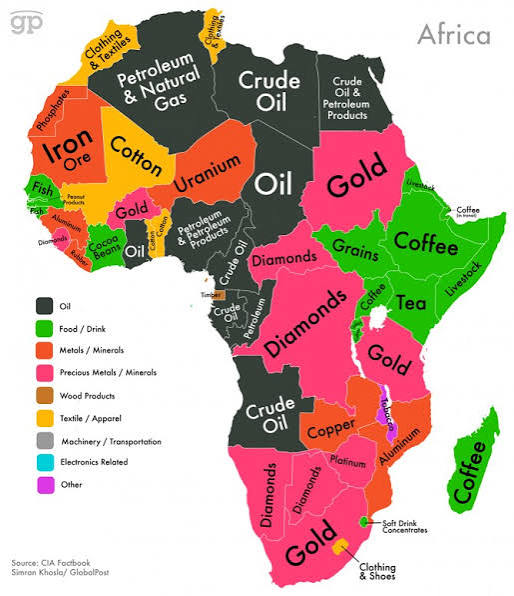
However, geopolitical rivalry can offer an opportunity to Africa and can also accentuate the continent’s historic and deep economic fragilities. The African economies have been mostly relying on raw materials exportation, where the finished products are imported for decades. The continent enters the oil, gas, cocoa, copper, cobalt, lithium, and other commodities without ever having been processed to any extent, and then leaves with the manufactured products, which commands a much higher price by the time they reach the continent’s shores. The result is an economy where off the assets of Africa, there are a lot of resources or bangs of it with limited value capture.
This situation may change or be reaffirmed because of the new rivalries that are developing within international geopolitics. An ever changing global shift to renewable energy, Electrical Vehicles, Artificial Intelligence and advanced technologies have raised critical mineral demand like carbon, cobalt, lithium, copper, manganese and graphite. Countries like Democratic Republic of Congo, Zambia & Zimbabwe are in the strategic position due to their mineral stores.
This trend could be an opportunity for African governments to enter into better economic relationships. But the continent should not make the same errors as it encountered in the past. Exports of raw materials without any processing and manufacturing capacity will keep the African economies at the bottom of the global value chain.
There is no one who could choose for Africa. It must have strategic capabilities with multiple partners in view of its own interests. The rule is to have a partnership without dependence. And this approach calls for the strengthening of African institutions. The unfortunate nature of the unequal agreement is that the countries with weaker institutions and unstable policies will be more vulnerable. There is therefore no good reason why such institutions, contracts, policies, and governance are not political ideals but are actually present. These are economic resources that have an impact on the benefit that African countries are able to gain from foreign investments.
African nations need to remedy the more real-world challenges that still hamper intra-African trade. Poor transport infrastructure, high transport costs, bureaucratic hurdles, multiple taxes and inconsistent regulations remain and continue to make trade with Africa more costly. These issues can be exacerbated by geopolitical tensions. Problems in relations between neighbouring countries can cause disruption of trade routes, closure of border crossings and postponed investment and business decisions.
Nigeria should recognise that its biggest economic opportunity may not lie in simply becoming a larger market for imported goods, rather in becoming a production hub for African markets. With a population of about 237.5 million in 2025, Nigeria already has one of the continent’s largest consumer bases, but the greater strategic opportunity is to use that scale to build industries capable of serving markets across Africa.
This matters because intra-African trade still accounts for only about 16% of the continent’s total trade, while African economies remain heavily dependent on external markets and imported manufactured goods. UNCTAD argues that stronger regional production networks and greater trade in value-added goods are essential to making African economies more resilient to external shocks.
For Nigeria, the implication is clear: population size should be treated not merely as a consumption advantage, rather as the foundation for industrial scale. The country should use its domestic market to attract investment in manufacturing, agro-processing, technology, pharmaceuticals and other tradable sectors, while deliberately building the infrastructure, standards and logistics required to export competitively across the continent.
The objective, therefore, should not be to provide a bigger market for foreign products in a country of more than 230 million people. It should be to turn Nigeria’s market into the launchpad for Nigerian-made products across Africa and to deliver the workforce, entrepreneurs, and consumers to support establishing industries that are globally competitive in Africa.
It is often said that the young people of Africa represent a “demographic dividend. Turning this demographic potential into a dividend will require investment in manufacturing, skills and productive jobs, enabling African countries to build industries that can meet rising domestic demand while competing in regional and global markets.
However, if there is no industrial development, demographic growth can aggravate unemployment, poverty and social instability. One of the issues has been the fear that Africa will be used by outsiders as a battleground in global politics. African countries should not be used as pawns in the rivalry games that will not benefit their economies in the long-run.
African countries need to promote greater cooperation with each other, enhance their negotiating power, and develop an investment code of practice for foreign investors investing in strategic areas. It’s important for the continent to increase cooperation on key minerals as well. Rather than states in Africa competing with each other to lure investment from abroad, they should devise plans to promote processing and manufacturing in Africa and technology transfer. The value of Africa’s resources shouldn’t end at the mine.
It should span from the factory to the laboratory, the technology company, and the African consumer. With the geopolitical shifts happening around the world, Africa is thus faced with a historic opportunity. The continent may be a supplier to the powerful economies while importing ready-made goods.
Global powers cannot be beaten for trying to take over Africa. However, it can set the conditions for their competition. The continent should not be a subject of a geopolitical game but an instrument of the making of the global economic order. We have resources; we need to make them available. The markets are in this place. The human population is in place.
Africa must now have the political will to translate these benefits into a negotiating power, industrialization, and prosperity. The geopolitical competition is changing Africa’s economy.
But the important question is which will happen: will Africa be reshaped by others or will Africans take this opportunity to reshape their own economic future?
Adeniran Abdbasit Adeyemi is a 2026 Free Trade Fellow at Ominira Initiative for Economic Advancement. He’s a journalist at Iseyin Pulse and can be reached via x @AbdbasitAdeyemi

Leave a Comment