
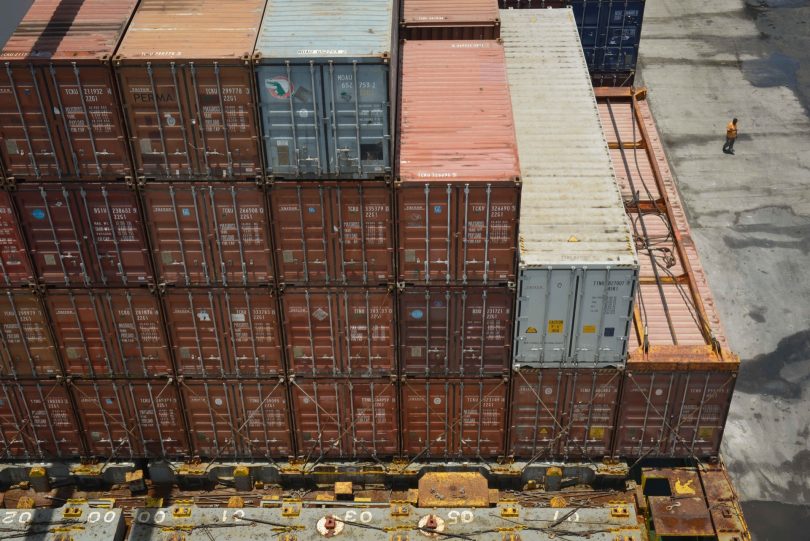

Walk into any market in Lagos, Kano, or Aba, and you will find Chinese goods on almost every shelf. Electronics, clothing, machinery, household items, and building materials. Most of it is manufactured, processed, packaged, and shipped from China to Nigeria. Now ask what Nigeria sends back in return. The answer, for decades, has been the same: crude oil, raw cocoa, unprocessed sesame seeds, and cashew nuts straight from the farm. My colleague explained it better when he said, “Nigeria sells the earth, but China sells the future.” And the latest trade data from the National Bureau of Statistics (NBS) suggest that, despite every promise of diversification, the arrangement has not changed as much as the headlines would have us believe.
According to NBS data, Nigeria’s Q1 2026 trade figures tell a story that deserves more scrutiny than it has received. Total exports reached N21.16 trillion, a figure that sounds impressive until you look at what is inside it. Crude oil accounted for N11.2 trillion of that total. Non-crude oil exports, a category that includes refined petroleum products and gas, added N6.78 trillion.
What remained for non-oil goods, the manufactured products, agricultural commodities, and processed exports that actually reflect productive economic activity, was just N3.18 trillion. That is roughly 15 percent of Nigeria’s total export value in the first quarter of 2026. For a country that has been promising to diversify its economy for the better part of three decades, that number is not a sign of progress. It is a measurement of how far there still is to go.
The structure of Nigeria’s trade is known in development economics. It is called the resource curse, and its logic is straightforward. A country rich in natural resources earns enough from exporting those resources to survive without building a broader productive base. The incentive to industrialise, to add value, to manufacture, never becomes urgent enough to overcome the political and institutional barriers that stand in its way. And so the pattern persists.
Nigeria’s export profile to its biggest trading partners confirms this pattern. According to the NBS Q1 2026 Foreign Trade in Goods Statistics, India received the largest share of Nigeria’s global exports at 13.09 percent, followed by France at 9.29 percent and the Netherlands at 9.22 percent. Look at what those countries are buying, and the picture is clear. India, France, and the Netherlands are among the world’s biggest importers of crude oil. They are not buying Nigerian-manufactured goods. They are buying Nigerian ground.
The relationship with China is even more revealing. China supplied 37.42 percent of all Nigerian imports in Q1 2026, worth N5.09 trillion, making it by far Nigeria’s biggest source of imported goods. The United States came second at 20.60 percent. According to Finance in Africa, China’s exports to Nigeria surged 37 percent to $13 billion in 2025, while the structure of trade remained largely unchanged, with Nigeria exporting mostly raw materials and importing higher-value finished and semi-finished goods. Nigeria recorded an $18 billion trade deficit with China in 2023, and analysts at BizWatch Nigeria note that in December 2025 alone, China exported $2.76 billion worth of goods to Nigeria while importing only $586 million in return. That is a monthly trade gap of $2.18 billion with a single country.
What does Nigeria send to China? According to UN COMTRADE data, mineral fuels and oils accounted for $1.75 billion of Nigeria’s exports to China in 2024. Ores, slag, and ash added $673 million. Salt, stone, and cement contributed $243 million. Copper $214 million. The pattern is consistent across every year: Nigeria exports raw materials and minerals. China processes them, manufactures goods, and sells the finished products back to Nigeria at a significant margin. Nigeria is, in the bluntest economic terms, outsourcing its own industrialisation to someone else.
The Lagos Chamber of Commerce and Industry’s Director General, Dr Chinyere Almona, captured this precisely when commenting on Nigeria’s surge in raw material exports in 2025. She acknowledged the short-term foreign exchange benefits but warned that the continued dominance of unprocessed and semi-processed commodities in Nigeria’s export profile underscores the economy’s limited progress in domestic value addition. That is a diplomatic way of saying that Nigeria is still selling its future cheap.
The numbers that flatter and the numbers that matter
To be fair to the data, there are genuine signs of movement. Non-oil exports reached a record $6.1 billion in 2025, according to the Nigerian Export Promotion Council, led by cocoa, urea fertiliser valued at $1.29 billion, cashew nuts at $456.9 million, and sesame seeds at $300.3 million. In 2025 alone, non-oil exports to African countries reached N4.9 trillion, and Nigeria exported 236 distinct products in the first half of 2025, up from 202 in the same period of 2024. These are not trivial gains.
But a closer look at what is actually being exported reveals the limits of that progress. Cocoa beans, sesame seeds, and cashew nuts are agricultural commodities exported in their raw or minimally processed form. Urea fertiliser is a petrochemical derivative, not a manufactured product in the traditional sense. Nigeria is not exporting automobiles, electronics, textiles, pharmaceuticals, or industrial machinery. It is exporting what comes out of the ground or off the farm, with minimal transformation in between. As African Liberty noted in its analysis of Nigeria’s diversification drive, without bold investment in infrastructure and aggressive value addition, the gains of 2025 will remain a footnote rather than a foundation.
The numbers that flatter Nigeria are the headline totals. The numbers that matter are the composition figures. And when you look at the composition, the story is about a country exporting more volume without fundamentally changing what it exports. That distinction is everything. Selling more cocoa beans is not the same as selling chocolate. Shipping more crude oil is not the same as exporting refined petroleum products or petrochemicals. The value that Nigeria is leaving on the table by not processing what it produces is not a rounding error. It is the difference between an emerging economy and a genuinely competitive one.
What AfCFTA cannot fix on its own
Nigeria’s AfCFTA membership is often cited as the answer to its trade diversification challenge. The argument is that access to a 1.3-billion-person continental market will give Nigerian businesses the demand they need to scale up production and move up the value chain. There is logic to this, but it is incomplete logic.
AfCFTA lowers tariffs. It does not build factories. It does not fix electricity supply. It neither trains engineers nor invests in agro-processing infrastructure. And crucially, it does not resolve the fundamental problem that Nigerian manufacturers face higher operating costs than their competitors in Morocco, Egypt, South Africa, and, increasingly, Ethiopia. If a Nigerian manufacturer competes in an open continental market while paying more for power, spending more on logistics, and navigating a more complicated regulatory environment than a Moroccan or Egyptian competitor, lower tariffs do not level the playing field. They just make the competition more visible.
China’s May 2026 decision to eliminate tariffs on imports from 53 African countries, including Nigeria, is a case in point. On paper, it is an opportunity. In practice, most Nigerian exporters lack the compliance infrastructure to fully take advantage of the policy. Nigeria’s export basket to China remains dangerously narrow, dominated by raw commodities that already face minimal tariffs. The former President of the Manufacturers Association of Nigeria, Mansur Ahmed, made the point directly: the zero-tariff regime must be matched with a shift towards producing semi-processed and finished goods rather than just raw material exports. Without that shift, a new trade preference is simply a new route for the same old commodities.
The Q1 2026 Africa trade data tells a similar story. Nigeria’s biggest African export destination is Togo at 26.49 percent of Africa exports, with N856 billion in non-crude oil goods. That figure sounds positive until you recognise that Togo is largely a transit economy. Much of what Nigeria ships to Lomé is moving on to landlocked neighbours rather than being consumed by Togolese citizens. Nigeria’s actual penetration of African consumer markets, the markets AfCFTA was designed to open, remains thin. South Africa is Nigeria’s biggest African import source at 23.71 per cent, followed by Angola at 22.21 per cent. The intra-African trade that AfCFTA promises is still more aspiration than reality.
The choice before us
There is a choice at the centre of Nigeria’s trade story that keeps getting deferred. It is the choice between an economy that extracts and exports, and an economy that processes and produces. Every serious economic analysis of Nigeria’s trade structure arrives at the same conclusion: the country must move up the value chain. It must add processing stages between the raw material and the export. It must build manufacturing capacity that converts natural endowments into competitive products. This is not a new insight. It has been the stated policy of every Nigerian government for the past 30 years.
What has been missing is not the analysis. It is the execution. Power supply remains unreliable and expensive for manufacturers. Industrial clusters lack the infrastructure to attract and retain investment. Access to finance for manufacturers and agro-processors is constrained. The regulatory environment penalises scale rather than rewarding it. And the easy revenue from crude oil continues to reduce the urgency of the harder work of building a productive economy.
The Q1 2026 NBS data is a mirror, showing a country that has made real progress in some areas, genuine growth in non-oil export volumes, a record trade surplus, and improving logistics performance. But it also shows a country whose export identity remains tied to what it digs up and picks from trees. N3.18 trillion in non-oil goods out of N21.16 trillion in total exports is not diversification. I chose to call it a dependency with a new coat of paint.
Nigeria has the agricultural base, the mineral wealth, the population, and the market position to build a genuinely diversified export economy. The ingredients have never been the problem. The question is whether the country will finally make the sustained, unglamorous investments in processing capacity, infrastructure, and industrial policy that turn those ingredients into something the world will pay a premium to buy. AfCFTA will not make that choice. China’s zero-tariff policy will not make that choice. The choice is Nigeria’s to make, and the data suggests it has not yet made it.
Victor Ejechi is a 2026 Free Trade Fellow at the Ominira Initiative. Ejechi is also a research analyst

Leave a Comment